Spitznagel Tail Hedge strategy
What turkeys can teach us about risk A group of turkeys is raised with great care on a farm. They are fed daily, and are protected by guard dogs. Some of the turkeys keep records of their lives, and the data shows a consistent uptrend: the amount of food they receive increases over time. Naturally, the turkeys make a prediction: “Because our lives have improved in the past, surely things will continue to get better! We will have more food, more safety, and more shelter moving forward.” Then Thanksgiving arrives. The farmer leads the turkeys to a shed and slaughters them.
The turkeys were so blinded by their data that their confidence peaked right before the disaster. Past data can create a false sense of security.
The third, and perhaps most important lesson, is that relying solely on the past is actively harmful. This habit isn't just mildly inaccurate; it is dangerous because it encourages us to let our guard down.
Learn to seek understanding over data. Ask why a trend exists, who benefits from it, and what would cause it to break. Layer these qualitative questions on top of your quantitative data. For the turkeys, the right questions were simple: Why are we being fed? What happens next? Can this continue forever? Even after gaining a deep understanding, you must remain open to the possibility of being wrong.
No matter how much you think you know, the list of things you do not know will always be longer. Spitznagel added that Universa was shorting the S&P 500, and the fund would gain 402% if the index dropped 10% in a month, or 10,251% if it plunged 30%
Universa Investments made an annual return on capital of 105.2% on its Black Swan Protection Protocol Fund during its first twelve years, according to documents seen exclusively by Business Insider. The document, a summary letter of an audit conducted by 'Big Four' accounting firm Ernst and Young (EY), spans from Mark Spitznagel's founding of Universa in 2008 to the end of 2019. Notably, this excludes the fund's famed 2020 gains, when it posted a 4,144% return in the first quarter.
In Universa's philosophy, which bears similarities to the economic theory of Ludwig von Mises, market crashes are inevitable. This means when positioned correctly, investors can decide to lose a small amount of money in some years to make big gains from any downturns. Essentially, you lose a little in the short term to make a lot in the long run.
"The goal for portfolio construction should be end-point wealth. You maximise your end-point wealth by maximising your geometric mean return. If you look at the universe of investing through that lens, you are going to see that: First, you would have only wanted to own equities for the past 100 years.
If you think about building a portfolio, you need to build it on risk, not on the probability of that risk.
For Universa, almost all historic market crashes were caused or exacerbated by over-valuation, and Yarckin argues that Fed interventions only exacerbate this.
Mark Spitznagel is a highly successful hedge fund manager and the author of a book we highly recommend called “The Dao of Capital.” Spitznagel uses Austrian school economic principles and extensive historical data to describe his unique perspectives on investing. In pages 244-248 of the book, he presents an options strategy that served him well in periods like today when valuations foreshadowed significant changes in market risk. The goal of the strategy is not to hedge against small or even moderate losses, as in the first two examples, but to protect and profit from severe tail risk that can destroy wealth like the recent experiences of 2000 and 2008.
Sptiznagel’s strategy hedges a market long position with put options expiring in two months. On a monthly basis, he sells the put options and buys new options expiring in two months. The strike price on his options are 30% below current prices. To replicate his strategy and compare it to the ones above we assume the following:
- Own 400 shares of SPY at a price of $246.80 per share at the cost of $98,720.
- The holding period is 1
- Purchase 82 SPY put options (equivalent to .50% of the portfolio value) with a strike price of $175 (30% out of the money), expiration of 9/15/2017 (2 months) at a cost of $.06 per share and total cost of $492. (Each option is equal to 100 shares)
- For purposes of this example, new options are purchased when the current options mature every two months (Spitznagel sells and buys new options on a monthly basis).
- We also assume this hedge was already in place for a year resulting in an accrued trade cost of 492) to date.
The graph below highlights the cost benefit analysis.

The strategy graphed above looks appealing given the dazzling reward potential, but we stress that the breakeven point on the trade is approximately 30% lower than current prices. While the cost difference to the right of the breakeven point looks relatively small, the axis’s on the graph have a wide range of prices and returns which visually minimizes the approximate 6% annual cost. Similar strategies can be developed whereby one gives up some gains in a severe drawdown in exchange for a lower cost profile.
Cost/Benefit Table
The tables below compare the strategies detailed above to give a sense of returns and a cost/benefit analysis across a wide range of SPY returns.
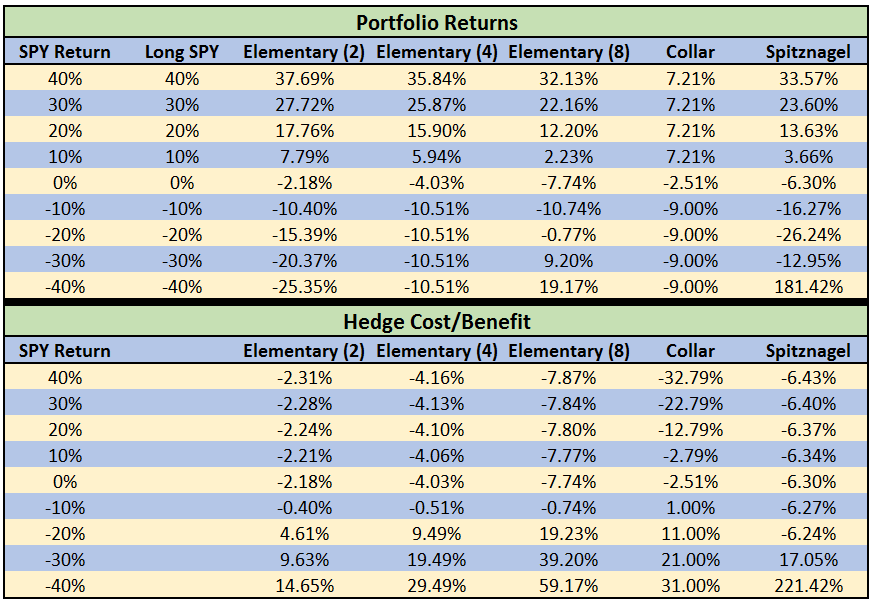
The option strategies in this article are designed for the initial stages of a decline. Pricing of options can rise rapidly as volatility, a key component of options prices, increases. The data shown above could be vastly different in a distressed market environment. These options strategies and many others can be customized to meet investor’s needs. > From <https://www.zerohedge.com/news/2017-10-04/protecting-your-blind-side-hedging-spitznagels-tail-strategy>
