Definitions
Secured Overnight Financing Rate (SOFR) is a secured overnight interest rate. SOFR is a reference rate (that is, a rate used by parties in commercial contracts that is outside their direct control) established as an alternative to LIBOR.
Ergodicity refers to a property of a system where every sequence or sizable sample is equally representative of the whole. Ergodicity implies that the long-term average of a system's behavior can be inferred from a single, sufficiently long observation of that system. In mathematics, ergodicity expresses the idea that a point of a moving system, either a dynamical system or a stochastic process, will eventually visit all parts of the space that the system moves in, in a uniform and random sense.
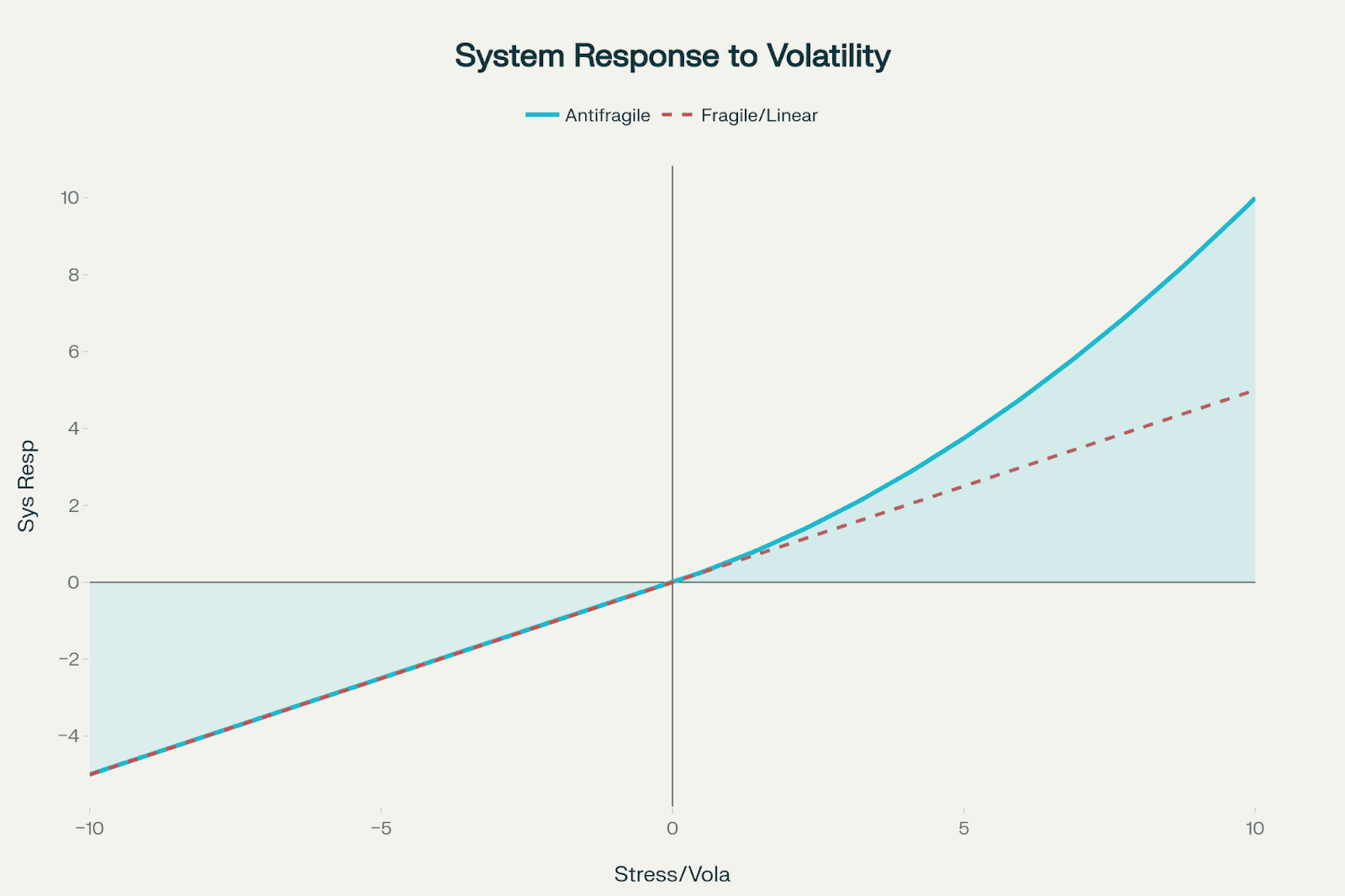
Convex
Factor Investing
Factor investing is an investment strategy that involves choosing securities based on attributes that are associated with higher returns. This type of investing aims to reduce risk that may otherwise be hidden in a portfolio of securities with similar exposure. Proponents of factor investing argue that this strategy allows investors to make better decisions. Value Value aims to capture excess returns from stocks that have low prices relative to their fundamental value. This is commonly tracked by price to book, price to earnings, dividends, and free cash flow. Size Historically, portfolios consisting of small-cap stocks exhibit greater returns than portfolios with just large-cap stocks. Investors can capture size by looking at the market capitalization of a stock. Momentum Stocks that have outperformed in the past tend to exhibit strong returns going forward. A momentum strategy is grounded in relative returns from three months to a one-year time frame. QualityQuality is defined by low debt, stable earnings, and consistent asset growth. Investors can identify quality stocks by using common financial metrics like a return to equity, debt to equity, and earnings variability. Volatility Empirical research suggests that stocks with low volatility earn greater risk-adjusted returns than highly volatile assets. Measuring standard deviation from a one- to three-year time frame is a common method of capturing beta.
Gamma represents the rate of change between an option's Delta and the underlying asset's price. Higher Gamma values indicate that the Delta could change dramatically with even very small price changes in the underlying stock or fund.
At-the-money options have the highest Gamma because their Deltas are the most sensitive to underlying price changes. For example, with XYZ at a market price of $100.00, a XYZ $100.00 call is at-the-money as XYZ is trading at the strike price of $100.00. Any movement in either direction will send the contract in-the-money or out-of-the-money. This means the contract is extremely sensitive to stock movement, which will be reflected in the option's Gamma — hence, Gamma is higher for at-the-money options.
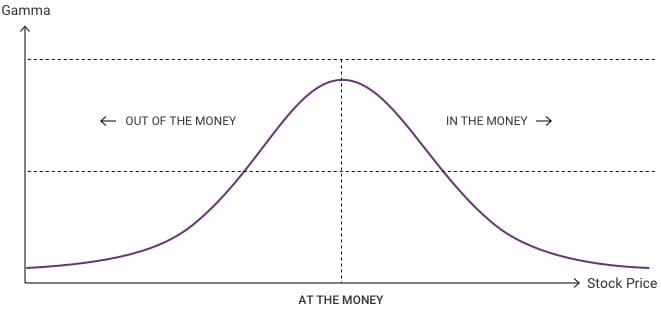
For illustrative purposes only.
For options that are near-the-money, Gamma increases as expiry approaches as time value is depleting and the option loses its extrinsic value and retains its intrinsic value. Gamma measures Delta and Delta measures intrinsic value. At expiration, options mainly price in their intrinsic value Therefore, close to expiration the Delta can have large, sudden moves between close to 0 (out-of-the-money) and close to 1 or -1 (in-the-money), which gets reflected in a very high Gamma. Essentially, higher Gamma means a higher change in Delta, which indicates a higher movement in the option's value when the stock moves $1.00 all else equal. Gamma is a positive value for long positions and a negative value for short positions — regardless if the contract is a call or a put.
