Strategy
- Reversal to the mean only works after big price changes
- Absent of indicator is also an indicator
- Clinging effect (hold on in defiance of logic)
- Adrenaline effect (buying in defiance of logic)
- Being wrong if there's is no cost then it doesn't matter
- No correlation, arbitrage doesn't work
Skewed bets with asymmetric outcome
It is not frequency but outcome/magnitude that drives payoff. Predict that the market over the next week has a 70% probability of going up and 30% probability of going down. However, on average it goes up by 1%, while it could go down by an average of 10%.
Don't take a bet on a wager that pays out 1$ with a probability of 99 out of 100 but 1 out of 100 you loose $1000.
Ideas
Arbitrage magnificent seven against S&P
- Magnificent Seven: as of 2024 these seven S&P500 companies are in a bloc: Meta, Microsoft, Alphabet, Amazon, Apple, Nvidia, and Tesla. The top seven stocks have so far in 2023 accounted for 80% of market gains, up from 2022 60%.
- Three European big names: ASML, Novo Nordisk and SAP. Without gains for the trio — which are all up at least 20% — the Stoxx 600 wouldn’t be in the green.
Rebalancing of index funds and trackers These funds typically trade at the last moment to complete their trades on rebalancing day to reconstitute the portfolio to minimize tracking errors. That means that they sell either to high (most likely) or too low. Since these changes like IPOs, delisting, additions, deletions, new seasoned issuance, and buybacks are known beforehand.
After a big price jump search twitter for postings for reason. If none can be found then do not open (or close) position i.e. liquidate.
Mandelbrot’s alternative approach is based on new parameters that would replace the mean and standard deviation. His first parameter is Alpha, derived from Pareto's Law, is an exponent that measures how wildly prices vary. It defines how fat the tails of the price change curve are. The second one, the H Coefficient, is an exponent that measures the dependence of price changes upon past changes.
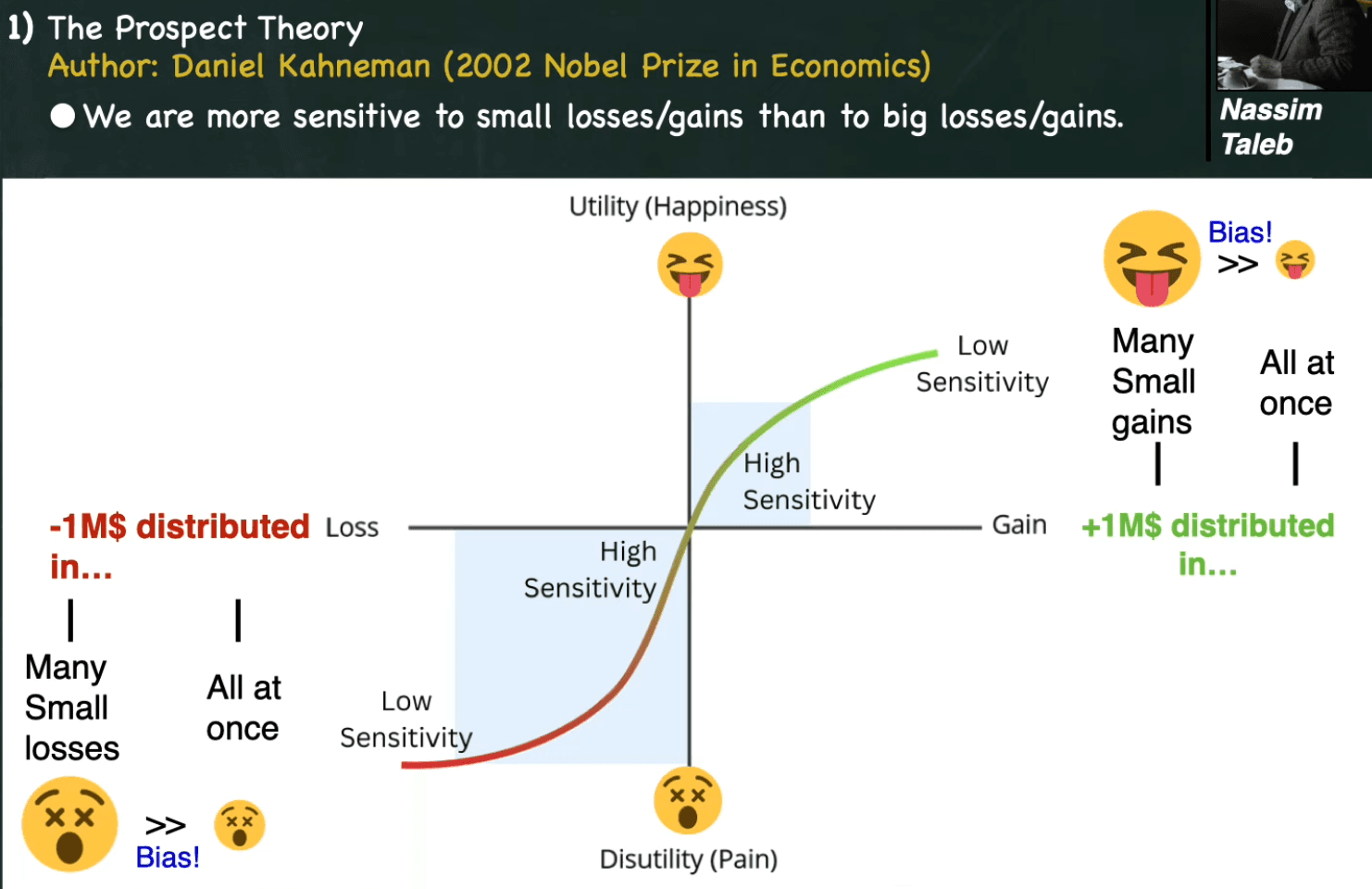
Prospect Theory, Kahneman
Momentum & Volatility Scaling
The combination of trend-following and volatility scaling is one of the most robust edges in systematic trading. But the way most practitioners implement the volatility side is flawed in ways that matter, and a recent paper from BlackRock’s AI Lab shows a cleaner path.
Read more here: https://algorithmictoken.substack.com/p/momentum-with-volatility-targeting
Momentum is among the most replicated findings in empirical finance. Assets that have performed well over a lookback window of roughly one to twelve months tend to continue performing well over the next month. This holds across equities, futures, FX, and commodities. The underlying mechanism is debated — behavioral explanations (underreaction, herding), structural ones (trend-following flows creating their own continuation) — but the empirical regularity itself is not seriously in dispute.
Volatility targeting is the natural complement. If you size your momentum position proportional to the signal but inversely proportional to recent volatility, you achieve two things at once: the strategy allocates more aggressively in calm markets where conviction is cheaper, and it deleverages automatically before and during turbulent periods when signals are noisiest and drawdowns most painful.
Together, the combination produces something that neither approach achieves alone: a strategy with trend-following upside, substantially lower drawdowns than unscaled momentum, and a more stable risk profile across market regimes. The academic literature has documented Sharpe ratio improvements of 0.2–0.4 from adding volatility targeting to momentum strategies, with the improvement most visible in tail risk reduction.
“Volatility targeting does not improve returns. It improves the ratio of returns to risk — and it does so precisely when you most need it to.”
