Little Red Riding Hood - Wikipedia
Little Red Riding Hood
Layer Cake speech
You're born, you take shit. You get out in the world, you take more shit. You climb a little higher, you take less shit. Till one day you're up in the rarefied atmosphere and you've forgotten what shit even looks like. Welcome to the layer cake son.
Cicerco conversation
Cicero grew weary of listening to the same old military anecdotes – usually illustrated by the manoeuvring of plates and decanters around the dinner table – of how the young general had outwitted three Marian armies at Auximum, or killed seventeen thousand Numidians in a single afternoon at the age of twenty-four, or finally defeated the Spanish rebels near Valencia. Pompey had been giving orders since he was seventeen and perhaps for this reason had developed none of Cicero’s subtlety of intellect. Conversation as the senator enjoyed it – spontaneous wit, shared gossip, sharp observations which might be spun off mutually into some profound or fantastic dissertation on the nature of human affairs – all this was alien to Pompey. The general liked to hold forth against a background of respectful silence, assert some platitude, and then sit back and bask in the flattery of his guests.
Cheap bastards
Have you heard the story about the couple who celebrated their 50th wedding anniversary at an elegant restaurant with their three sons? The father was chagrined to find that none of the sons had given them presents for the occasion. After the meal was over, the father said: “There's something your mother and I have been meaning to tell you for years. We were never married.” The sons gasped and the youngest son blurted: “You mean we are all bastards?” “Yes,” said the father, “and cheap ones too!”
True Romance
Ya know, I read a lot. Especially about things… about history. I find that shit fascinating. Here's a fact I don't know whether you know or not. Sicilians were spawned by niggers. It's a fact. Yeah. You see, uh, Sicilians have, uh, black blood pumpin' through their hearts. Hey, no, if eh, if eh, if you don't believe me, uh, you can look it up. Hundreds and hundreds of years ago, uh, you see, uh, the Moors conquered Sicily. And the Moors are niggers. So you see, way back then, uh, Sicilians were like, uh, wops from Northern Italy. Ah, they all had blonde hair and blue eyes, but, uh, well, then the Moors moved in there, and uh, well, they changed the whole country. They did so much fuckin' with Sicilian women, huh? That they changed the whole bloodline forever. That's why blonde hair and blue eyes became black hair and dark skin. You know, it's absolutely amazing to me to think that to this day, hundreds of years later, that, uh, that Sicilians still carry that nigger gene. Now this…No, I'm, no, I'm quoting… history. It's written. It's a fact, it's written. Your ancestors are niggers. Uh-huh. Hey. Yeah. And, and your great-great-great-great grandmother fucked a nigger, ho, ho, yeah, and she had a half-nigger kid… now, if that's a fact, tell me, am I lying? 'Cause you, you're part eggplant.
Seven Blind man
Many years ago in a valley in India lived six old men, each of whom was convinced of his own wisdom. Although they had never left the valley and, indeed, had all been blind since birth, they would compete with each other to see who had the greatest knowledge of the world. One day, they began to argue, and the object of their dispute was the elephant. Now, since each was blind, none had ever seen an elephant, so to satisfy themselves and settle the argument, they decided to go look for one. They hired a young guide, and set out early one morning in single file along the forest track, each placing his hands on the back of the man in front. It was not long before they came to a forest clearing where a huge elephant, quite tame, was grazing. The men took turns to investigate the elephant's shape and form.
The first man felt the beast's broad side. "Ah!" he cried, "The elephant is like mud bricks!" "What foolishness" the others murmured.
And when the second man's turn came, he approached the animal from the front, where he encountered the elephant's tusks. "Bah!" he exclaimed, "He is exactly like a spear!" But the others did not believe him.
The third man approached the elephant from the rear where the first object he touched was the elephant's tail. "You idiots!" he shouted. "The elephant is like a rope!' The others shook their heads sadly. The fourth, as had the second, approached from the front, and soon his groping hands grasped a long, squirming object that curled around his waist. "Where are your brains?" he asked. "The elephant is a serpent!" The others snorted their contempt.
The fifth, a tall and rangy fellow with a long white beard, chanced to touch the elephant's ear. 'Why my brothers!' he called out, "Anyone can tell what the elephant resembles most. He's shaped just like a fan!" The others chuckled in pity.
At last, it was the turn of the sixth. He was a small man, and bowed down with age, and he crept forward slowly until he ran into the elephant's leg. After feeling it gently with both his hands, he called out to the others. "You are wrong, my friends" he said. "The elephant is like a tree." And since all of the others had already "seen" the elephant, they were sure he was becoming addled. Feeling quite satisfied with themselves, the men returned home. And for the rest of their lives, each seated in a special place in the town square, the six blind men told their tales of the elephant. Each now had his own opinion, firmly based on his own experience, and each attracted his followers - for that is the way of the world.
The Blind Men and the Elephant The Blind Leading the Blind You are blind because you believe you can see, not because you cannot see.
It used to be that these beastly situations were derisively referred to as "the blind leading the blind," and the traditional solution was to assign one of the blind men the authority to decide, as if he could somehow see the whole elephant. Such tactics create compliance, but never the juicy involvement projects demand.
This blindness is a continuing feature of work life today. Consider your last project. Didn't it require the enthusiastic contribution of several different specialists, each unavoidably blind to all but his own perspective?
If your project succeeded, did the plan predict the path you ended up following? Chances are you succeeded by figuring out how to blindly lead each other to success—not by following some omniscient leader or predictive plan, but by somehow integrating the disparate perspectives of all of the "blind men."
If you were fortunate and saw the elephant together, that integration produced the all-too-rare experience of being able to see the world through each other's eyes. By the end of the effort, you might have even felt that your group could accomplish anything together. If you were not successful in achieving this integration, I'll bet you got a taste of a theologic war, only to hope you'd never have to work with any of those idiots again.
We Have Met the Enemy and He Is Us!
I use Saxe's old fable to explain a unique model for creating exceptional results with others. The outdated follow-the-leader model, with its emphasis on planning, tracking, and controlling, falls apart in a workplace in which the blind must lead the blind. The key to success now lies in knowing how to avoid the theologic wars that destroy every possibility for a mutually satisfying experience.
Why haven't project-management books talked about how to make the elephant appear? Without these simple, often overlooked elements, project work too easily degrades into the dead-end drudgery of theologic wars.
Those who know how to lead while acknowledging their own blindness create those magical experiences where, at the end, everyone wants to do another project like that again.
Saxe's blind men were not encumbered by their blindness, but by their certainty that they could see when they could not. If you want to create the extraordinarily satisfying experiences that coherence brings to project work, consider learning how to embrace your own, and everyone else's, inevitable blindness in the pursuit of your common objective.
What You Can Do to See the Elephant
- Be clear about your own purpose for engaging. When you sacrifice yourself for your project's objective, you quietly undermine your own abilities to create a meaningful experience. Those who are clear about their own purpose are most capable of appreciating others' purposes, too.
It seems that until you are selfish enough to know what you want, you're never generous enough to help anyone else pursue what they want. So finding a juicy personal purpose for your participation is an essential element of any coherent experience.
- Understand your intentions. The methods you devise for achieving your goal will most certainly fail. Yet if you are clear about your intentions, you can benevolently undermine the system you put in place so it can work.
If you are unclear about your own intentions, you will follow blindly. Like a good soldier, you will pursue what you suspect won't work and create your own misery in the process.
- Extend your trust. Extending your trust is the price of sitting at the same table. It is human nature for people to satisfy others' expectations of them. If you treat others as untrustworthy, they quite naturally give you what you ask for.
How can others prove themselves trustworthy if you don't first extend them your trust? The blind men's theologic war thrived on their mutual distrust of their fellows' curious stories.
- Let go of how it's supposed to be. You waste a lot of time defining roles and responsibilities—cordoning others into defendable spaces—when projects thrive instead in a network of community.
Interact in surprising, indefinable ways to achieve the coherence your project requires. Staying in role merely imprisons your best, enthusiastic selves.
- Stop trying to motivate others. Help others find their project within the project instead, and motivation automatically takes care of itself. What better motivation than knowing that your assignment is the medium within which you are actively pursuing your own, juicy objective?
Even the most difficult work can be juicy when supported by this simple, often overlooked element. Help others find their own motivation while you attend to discovering yours.
- Sit in the mess before tidying it up. Too often you start your projects by organizing the effort, hoping to avoid that uncomfortable messiness that leaves you feeling as if you will never make any headway.
Do not insist upon a well-formed starting place. Sit comfortably in the mess so you can learn about its nature before trying to organize or "fix" it. This essential milling-around period allows order to emerge from the mess and marks the start of a coherent, collective effort.
Little Red Riding Hood
(French: Le Petit Chaperon rouge*, German: Rotkäppchen, Italian: Cappuccetto Rosso) is a fairy tale about a young girl and a Big Bad Wolf.[^4] [^5] Some later versions include a woodsman. Its origins can be traced back to several pre-17th-century European folk tales (including in present-day France, Italy, and German-speaking regions),[^6] with parallels in ancient oral narratives and motifs; it was first recorded in literary form in French by Charles Perrault, and later retold in the 19th-century by the Brothers Grimm.
The story has varied considerably in different versions over the centuries, translations, and as the subject of numerous modern adaptations. Other names for the story are " Little Red Cap " or simply " Red Riding Hood ". It is number 333 in the Aarne–Thompson classification system for folktales.[^7]
Plot

"Little Red Riding Hood" as illustrated in a 1927 story anthology
The story revolves around a girl named Little Red Riding Hood, named after the red hooded cape that she wears. The girl walks through the woods to deliver food to her sickly grandmother (wine and cake depending on the translation).
A stalking wolf wants to eat the girl and the food in the basket. After he inquires as to where she is going, he suggests that she pick some flowers as a present for her grandmother. While she goes in search of flowers, he goes to the grandmother's house and gains entry by pretending to be Riding Hood. He swallows the grandmother whole, climbs into her bed, and waits for the girl, disguised as the grandmother.

Gustave Doré 's engraving of the scene "She was astonished to see how her grandmother looked."
When Riding Hood arrives, she notices the strange appearance of her "grandmother". After some back and forth, Riding Hood comments on the wolf's teeth, at which point the wolf leaps out of bed and eats her as well. In Charles Perrault's version of the story, the first to be published, the wolf falls asleep afterwards, whereupon the story ends.
In later versions, the story continues: A woodsman (German: Jäger, lit.' hunter ') in the Brothers Grimm and traditional German versions comes to the rescue with an axe, and cuts open the sleeping wolf. Little Red Riding Hood and her grandmother emerge shaken, but unharmed. They then fill the wolf's body with heavy stones. The wolf awakens and attempts to flee, but the stones cause him to collapse and die. In the Grimms' version, the wolf leaves the house and tries to drink out of a well, but the stones in his stomach cause him to fall in and drown (similarly to the story of " The Wolf and the Seven Little Kids ").
Sanitized versions of the story have the grandmother locked in the closet rather than being eaten (and also having the wolf eat the food Little Red Riding Hood brought rather than her) and some have Little Red Riding Hood saved by the lumberjack as the wolf advances on her rather than after she is eaten, where the woodcutter kills or simply chases away the wolf with his axe.[^8]
History

A "Little Red Riding Hood" illustration by Arthur Rackham 9
The story displays similarities to stories from classical Greece and Rome. Scholar Graham Anderson has compared the story to a local legend recounted by Pausanias in which, each year, a virgin girl was offered to a malevolent spirit dressed in the skin of a wolf, who raped the girl. Then, one year, the boxer Euthymos came along, slew the spirit, and married the girl who had been offered as a sacrifice.[^10] There are also a number of different stories recounted by Greek authors involving a woman named Pyrrha (literally "fire") and a man with some name meaning "wolf".[^11] The Roman poet Horace alludes to a tale in which a male child is rescued alive from the belly of Lamia, an ogress in classical mythology.[^12]
The dialogue between the wolf and Little Red Riding Hood has analogies to the Norse Þrymskviða from the Elder Edda; the giant Þrymr had stolen Mjölnir, Thor 's hammer, and demanded Freyja as his bride for its return. Instead, the gods dressed Thor as a bride and sent him. When the giants note Thor's unladylike eyes, eating, and drinking, Loki explains them as Freyja's not having slept, eaten, or drunk, out of longing for the wedding.[^13] A parallel to another Norse myth, the chase and eventual murder of the sun goddess by the wolf Sköll, has also been drawn.[^14]
A similar story also belongs to the North African tradition, namely in Kabylia, where a number of versions are attested.[^15] The theme of the little girl who visits her (grand)dad in his cabin and is recognized by the sound of her bracelets constitutes the refrain of a well-known song by the modern singer Idir, " A Vava Inouva ":
I beseech you, open the door for me, father. Jingle your bracelets, oh my daughter Ghriba. I'm afraid of the monster in the forest, father. I, too, am afraid, oh my daughter Ghriba.[^16]
The theme of the ravening wolf and of the creature released unharmed from its belly is also reflected in the Russian tale " Peter and the Wolf " and another Grimm tale " The Wolf and the Seven Young Goats ", but its general theme of restoration is at least as old as the biblical story, " Jonah and the Whale ". The theme also appears in the story of the life of Saint Margaret, wherein the saint emerges unharmed from the belly of a dragon, and in the short story "The Red Path" by Jim C. Hines.
A Taiwanese story from the 16th century, known as Aunt Tiger bears several striking similarities. In this story there are two girls who are sisters. When the girls' mother goes out, the tigress comes to the girls' house and pretends to be their aunt, asking to come in. One girl says that the aunt's voice does not sound right, so the tigress attempts to disguise her voice. Then, the girl says that the aunt's hands feel too coarse, so the tigress attempts to make her paws smoother. When finally the tigress gains entry, she eats the girl's sister. The girl comes up with a ruse to go outside and fetch some food for her aunt. Aunt Tiger, suspicious of the girl, ties a rope to her leg. The girl ties a bucket to the rope to fool her, but Aunt Tiger realizes this and chases after her, whereupon she climbs into a tree. The girl tells the tigress that she will let her eat her, but first, she would like to feed her some fruit from the tree. The tigress comes closer to eat the fruit, whereupon the girl pours boiling hot oil down her throat, killing her.[^17]
According to Paul Delarue, a similar narrative is found in East Asian stories, namely, in China, Korea [^18] and Japan, with the title "The Tiger and the Children".[^19]
Earliest versions

"The better to see you with!" woodcut by Walter Crane
The origins of the Little Red Riding Hood story can be traced to several likely pre-17th-century versions from various European countries. Some of these are significantly different from the currently known, Grimms-inspired version. It was told by French peasants in the 10th century [^4] and recorded by the cathedral schoolmaster Egbert of Liège.[^20] A 15th-century collection of folklore described an anecdote about a woman whose husband was a werewolf.[^21] However, it bears little resemblance to Perrault's text.[^22] In Italy, Little Red Riding Hood was told by peasants in the 14th century, where many versions exist, including La finta nonna (The False Grandmother), written among others by Italo Calvino in the Italian Folktales collection.[^23] It has also been called "The Story of Grandmother". It is also possible that this early tale has roots in very similar East Asian tales (e.g. "Grandaunt Tiger").[^24]
These early variations of the tale do differ from the currently known version in several ways. The antagonist is not always a wolf, but sometimes a 'bzou' (werewolf), making these tales relevant to the werewolf trials (similar to witch trials) of the time (e.g. the trial of Peter Stumpp).[^25] [^26] [^27] The wolf usually leaves the grandmother's blood and flesh for the girl to eat, who then unwittingly cannibalizes her grandmother. Furthermore, the wolf was also known to ask her to take off her clothing and throw it into the fire.[^28] In some versions, the wolf eats the girl after she gets into bed with him, and the story ends there.[^29] In others, she sees through his disguise and tries to escape, complaining to her "grandmother" that she needs to defecate and would not wish to do so in the bed. The wolf reluctantly lets her go, tied to a piece of string so she does not get away. The girl slips the string over something else and runs off. In these stories, she escapes with no help from any male or older female figure, instead using her own cunning, or in some versions, the help of a younger boy whom she happens to run into.[^30] Sometimes, though more rarely, the red hood is even non-existent.[^29]
In other tellings of the story, the wolf chases after Little Red Riding Hood. She escapes with the help of some laundresses, who spread a sheet taut over a river so she may escape. When the wolf follows Red over the bridge of cloth, the sheet is released, and the wolf drowns in the river.[^31] And in another version, the wolf is pushed into the fire, while he is preparing the flesh of the grandmother to be eaten by the girl.[^29]

French images, like this 19th-century painting, show the much shorter red chaperon being worn.
The earliest known printed version [^1] was known as Le Petit Chaperon Rouge and may have had its origins in 17th-century French folklore. It was included in the collection Tales and Stories of the Past with Morals. Tales of Mother Goose (Histoires et contes du temps passé, avec des moralités. Contes de ma mère l'Oye), in 1697, by Charles Perrault. As the title implies, this version [^32] is both more sinister and more overtly moralized than the later ones. The redness of the hood, which has been given symbolic significance in many interpretations of the tale, was a detail introduced by Perrault.[^33]
The story had as its subject an "attractive, well-bred young lady", a village girl of the country being deceived into giving a wolf she encountered the information he needed to find her grandmother's house successfully and eat the old woman while at the same time avoiding being noticed by woodcutters working in the nearby forest. Then he proceeded to lay a trap for Red Riding Hood. Little Red Riding Hood ends up being asked to climb into the bed before being eaten by the wolf, where the story ends. The wolf emerges as the victor of the encounter, and there is no happy ending.
Charles Perrault explained the 'moral' at the end of the tale [^34] so that no doubt is left to his intended meaning:
From this story one learns that children, especially young lasses, pretty, courteous and well-bred, do very wrong to listen to strangers, And it is not an unheard thing if the Wolf is thereby provided with his dinner. I say Wolf, for all wolves are not of the same sort; there is one kind with an amenable disposition – neither noisy, nor hateful, nor angry, but tame, obliging and gentle, following the young maids in the streets, even into their homes. Alas! Who does not know that these gentle wolves are of all such creatures the most dangerous!
This, the presumed original version of the tale, was written for the late 17th-century French court of King Louis XIV. This audience, whom the King entertained with extravagant parties, presumably would take from the story's intended meaning.
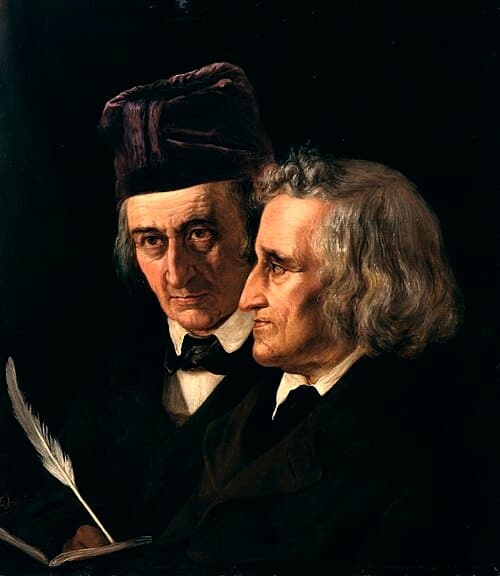
Wilhelm (left) and Jacob Grimm, from an 1855 painting by Elisabeth Jerichau-Baumann
In the 19th century two separate German versions were retold to Jacob Grimm and his younger brother Wilhelm Grimm, known as the Brothers Grimm, the first by Jeanette Hassenpflug (1791–1860) and the second by Marie Hassenpflug (1788–1856). The brothers turned the first version to the main body of the story and the second into a sequel of it. The story as Rotkäppchen was included in the first edition of their collection Kinder- und Hausmärchen (Children's and Household Tales (1812) – KHM 26).[^35] [^36]
The earlier parts of the tale agree so closely with Perrault's variant that it is almost certainly the source of the tale.[^37] This version ends with the girl and her grandmother saved by a huntsman who was after the wolf's skin; this ending mirrors that in the tale " The Wolf and the Seven Young Kids ", which appears to be the source.[^38] The second part featured the girl and her grandmother trapping and killing another wolf, this time anticipating his moves based on their experience with the previous one. The girl did not leave the path when the wolf spoke to her, her grandmother locked the door to keep it out, and when the wolf lurked, the grandmother had Little Red Riding Hood put a trough under the chimney and fill it with water that sausages had been cooked in; the smell lured the wolf down, and it drowned.[^39]
The Brothers further revised the story in later editions and it reached the above-mentioned final and better-known version in the 1857 edition of their work.[^40] It is notably tamer than the older stories which contained darker themes.
Later versions
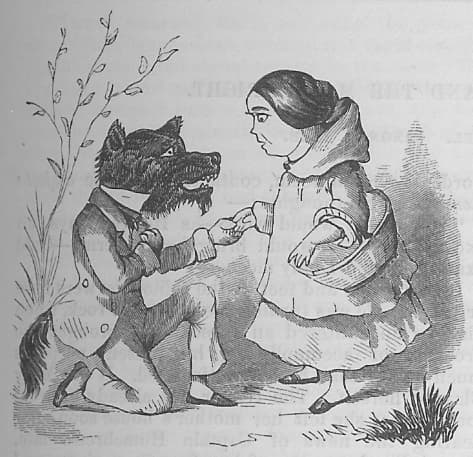
An engraving from the Cyclopedia of Wit and Humor
Numerous authors have rewritten, adapted, or collected variants of this tale.
Charles Marelle in his version of the fairy tale called "The True History of Little Goldenhood" (1888) gives the girl a real name – Blanchette.
Andrew Lang included a variant called "The True History of Little Goldenhood" [^41] in The Red Fairy Book (1890). He derived it from the works of Charles Marelles,[^42] in Contes of Charles Marelles. This version explicitly states that the story had been mistold earlier. The girl is saved, but not by the huntsman; when the wolf tries to eat her, its mouth is burned by the golden hood she wears, which is enchanted.
James N. Barker wrote a variation of Little Red Riding Hood in 1827 as an approximately 1000-word story. It was later reprinted in 1858 in a book of collected stories edited by William E Burton, called the Cyclopedia of Wit and Humor. The reprint also features a wood engraving of a clothed wolf on a bended knee holding Little Red Riding Hood's hand.

Little Red Riding Hood in Fairytale Themapark Efteling in North-Brabant
Jack Zipes anthologized several 19th-century variants.[^43]
Northcote Whitridge Thomas included a variant with a male protagonist in his report of the Igbo people.[^44]
An Iranian variant, featuring a little boy and the disrobing motif, appears in a 20th-century French anthology.[^45]
Geneviève Massignon recorded a variant called "Boudin-Boudine" from an informant in Le Gué-de-Velluire. In this version, a little boy is protected from the wolf by his grandmother and father.[^46]
Interpretations

A depiction by Gustave Doré, 1883
Apart from the overt warning about talking to strangers, there are many interpretations of the classic fairy tale, many of them sexual.[^47] Some are listed below.
Natural cycles
Folklorists and cultural anthropologists, such as P. Saintyves and Edward Burnett Tylor, saw "Little Red Riding Hood" in terms of solar myths and other naturally occurring cycles. Her red hood could represent the bright sun which is ultimately swallowed by the terrible night (the wolf), and the variations in which she is cut out of the wolf's belly represent the dawn.[^48] In this interpretation, there is a connection between the wolf of this tale and Sköll, the wolf in Norse mythology that will swallow the personified Sun at Ragnarök, or Fenrir.[^14] Alternatively, the tale could be about the season of spring or the month of May, escaping the winter.[^14]

Rite
The tale has been interpreted as a puberty rite, stemming from a prehistoric origin (sometimes an origin stemming from a previous matriarchal era).[^14] The girl, leaving home, enters a liminal state and by going through the acts of the tale, is transformed into an adult woman by the act of coming out of the wolf's stomach.[^14]
Rebirth
Bruno Bettelheim, in The Uses of Enchantment: The Meaning and Importance of Fairy Tales (1976), recast the Little Red Riding Hood motif in terms of classic Freudian analysis, that shows how fairy tales educate, support, and liberate children's emotions. The motif of the huntsman cutting open the wolf he interpreted as a "rebirth"; the girl who foolishly listened to the wolf has been reborn as a new person.[^49]
Norse myth
The poem " Þrymskviða " from the Poetic Edda mirrors some elements of Red Riding Hood. Loki 's explanations for the strange behavior of " Freyja " (actually Thor disguised as Freyja) mirror the wolf's explanations for his strange appearance. The red hood has often been given great importance in many interpretations, with a significance from the dawn to blood.[^14]
A sexual analysis of the tale may also include negative connotations in terms of rape or abduction. In Against Our Will, Susan Brownmiller describes the fairy tale as allegory of rape.[^50] Many revisionist versions focus on empowerment and depict Little Red Riding Hood or the grandmother successfully defending herself against the wolf.[^51]
Such tellings bear some similarity to the "animal bridegroom" tales, such as Beauty and the Beast or The Frog Prince, but where the heroines of those tales revert the hero to a prince, these tellings of Little Red Riding Hood reveal to the heroine that she has a wild nature like the hero's.[^52] These interpretations reframe the story as one of female empowerment and do not characterize Little Red Riding Hood as a victim.

