Methodology
Quadrant method
Alternaive quardrants: Eisenhauer matrix
- ASAP
- In progress
- Schedule
- Someday
quadrantChart
    title Quadrant notetaking method
    x-axis ToDo --> Back Burner
    y-axis Now --> Later
    quadrant-1 General Notes
    quadrant-2 Questions
    quadrant-3 Action Today
    quadrant-4 Low Priority

    "Quick Win A": [0.2, 0.8]
    "Major Initiative B": [0.7, 0.8]
    "Tasks (Prioritized)": [0.2, 0.1]
    "Long-term Strategy D": [0.7, 0.1]
CETAC method of organization
- capture
- explain
- track
- aggregate
- contextualize
The Epictetus method:
- What did I do well?
- What did I do wrong?
- What duty remains undone?
Bullet Journal
track the past, order the present, design the future. Journal starts with an index. Tasks that are moved forward are updated in the index Three basic items:
- Tasks
- Events
- Notes De missie achter de methode is dat je bewust wordt van hoe je jouw tijd en energie besteedt. Zo kun je intentioneel leven: je reflecteert op een creatieve manier op je leven. Je maakt geen ellenlange to-dolijstjes meer. maar je schrijft je doelen op, werkt ernaartoe en onderweg reflecteer je erop. In plaats van lijstjes maak je ‘logs’ van taken en afspraken. met als resultaat: meer overzicht en minder stress.
QEC method
- Question (Add a dot to the line of text)
- Evidence (Add a dash to the line of text)
- Conclusion (Highlight the text)
Latch method
Invented by Richard Saul Wurman Focus on metadata for storing information
- Location
- Alphabet
- Time
- Category
- Hierarchy
Atomic Notes
Draw the line between what should be made into atomic notes (externalized) and what should be memorized (internalized). The idea must contribute to an end, which can be anything from writing a whole book to solving a problem to strategizing for your life. The idea must be a generalized conclusion or the gist, not specifics. The first point naturally necessitates the note connecting to other notes.
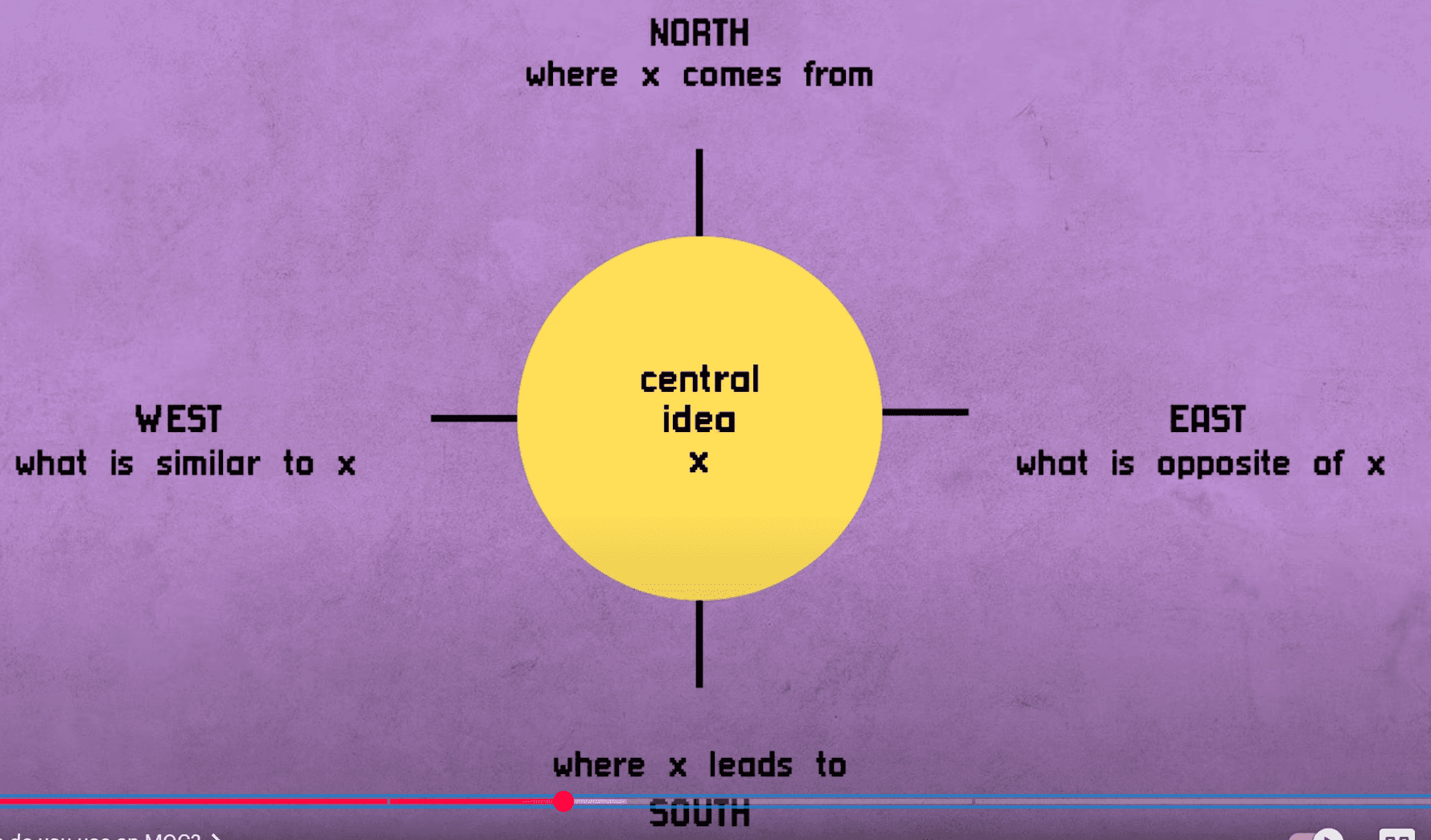 Atomic notes (aka smart notes) with compass navigation. Connections between notes enabled this type of navigation.
Stochastic
Stochastic note-taking" isn't a single defined method but refers to approaches where randomness or chance plays a key role in generating ideas or structuring notes, such as taking notes on random subjects for the Zettelkasten method, or using stochastic modes on electronic devices to introduce variations in note patterns. It can also describe the process of recording the outcomes of a stochastic process, like documenting the brands of cars passing by your window over time.
Methods and Applications
- Zettelkasten Method: One interpretation involves taking notes on random topics that come to mind, rather than sticking to a single project, to foster creative connections and unique ideas within a Zettelkasten system.
- Musical Sequencing: In music, "stochastic mode" in sequencers introduces random variations in pitch and rhythm, creating complex and evolving patterns based on probability settings.
- Observational Note-Taking: This involves observing and recording events or data points that are inherently random over time, such as documenting the types of cars that pass your window at different times. This forms a "discrete-time, discrete-state space stochastic process".
- Note-Taking in Simulations: In technical fields, taking notes on the outcomes of a stochastic process, such as the results of a randomized simulation, can also be considered a form of stochastic note-taking.
Key Concepts:
- Stochastic Processes. At its core, stochastic note-taking is linked to the concept of a stochastic process, which is the evolution of a random variable over time.
- Randomness: The presence of random variables at each "time" step is a defining characteristic.
- Probability: The choice of what to note and how to note it often involves probabilistic decisions.
- Data Collection: This can be as simple as recording random occurrences or as complex as building a system for generating and connecting ideas through random capture.
Scholastic Disputatio
I’ve moved away from standard "linear" notes and started treating my Obsidian vault as a Scholastic Disputatio. For those who don't know, this was the method used by thinkers like Thomas Aquinas and Augustine.
The Problem: I found that my notes were becoming a "graveyard of information." I had thousands of links but no real synthesis.
The Solution: I started structuring my core notes around the Dialectic Method. Here is how it looks in my vault now:
-
The Question (Questio): Every major note starts as a question.
-
The Objections (Videtur Quod): I am forced to write down at least two strong arguments against my current understanding. This ensures I’m not just in an echo chamber.
-
The Synthesis (Respondeo): Only after facing the objections do I write my own conclusion based on the evidence.
-
The Rebuttals (Ad Obiectiones): I go back and answer each specific objection.
The Result: My Graph View isn't just a mess of tags anymore; it’s a map of settled debates and logical connections. I call this my "Cathedral of Thought." Instead of being a passive collector, I’ve become a "Resurrector of the Scholastics" in the digital age.
It takes more time per note, but the retention and clarity are on another level. Has anyone else experimented with bringing ancient/classical methods into their PKM? I’d love to discuss how we can use these "old" tools for modern problems.
Non progredi est regredi.
