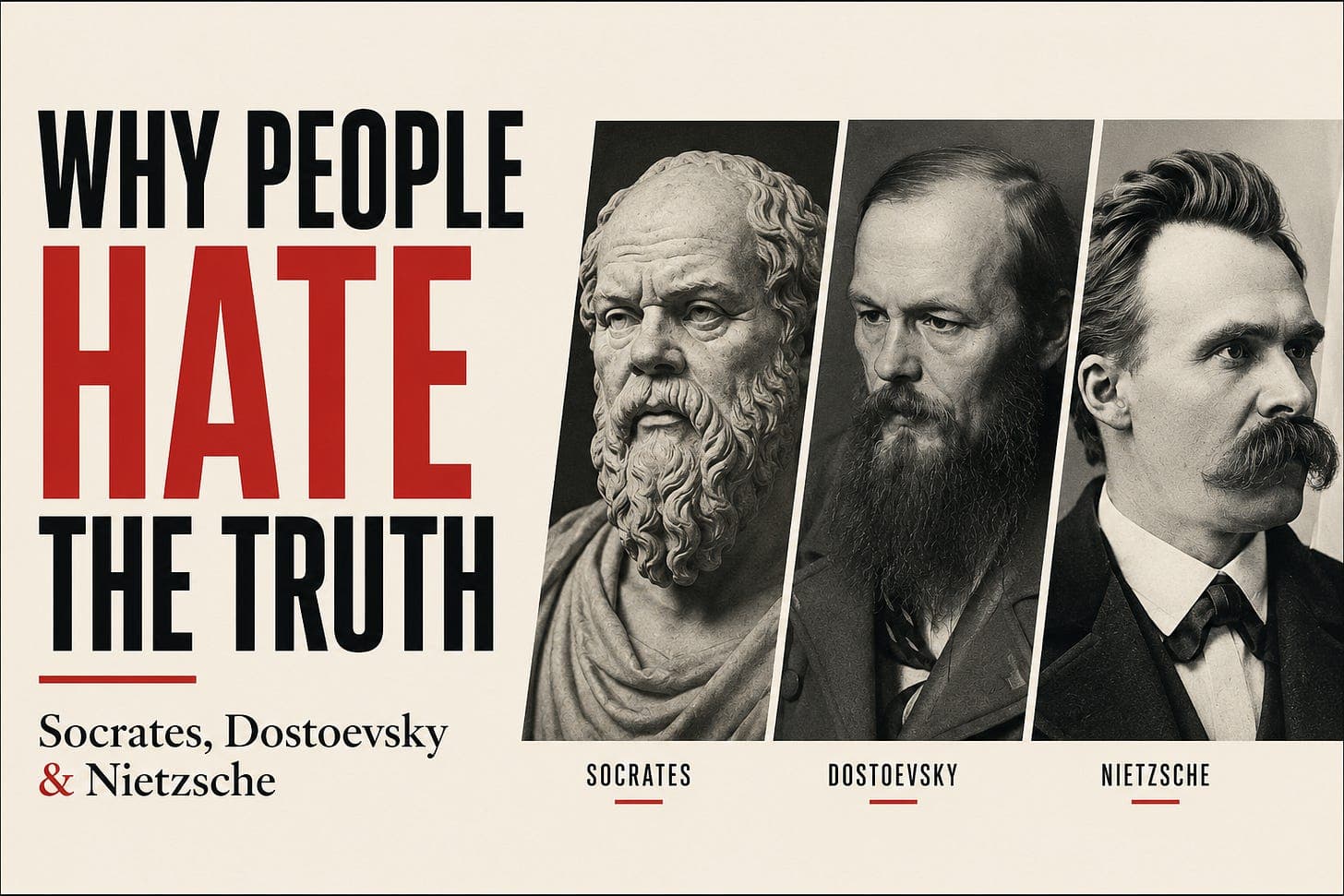
Why People Hate the Truth — Socrates, Dostoevsky & Nietzsche
In summary, the essay explores the idea that truth is often resisted because it challenges social status, personal comfort, and identity.
Headlines
- Socrates: Truth as a Social Discomfort. His questioning shattered illusions, leading to societal backlash and his execution.
- Dostoevsky: Self-Deception as a Shield. Characters in his novels preferred comforting lies over painful truths about themselves.
- Nietzsche: Convictions Over Truth. He proposed that people defend beliefs that maintain their identity over accepting uncomfortable facts.
Things
- People: Socrates, Fyodor Dostoevsky, Friedrich Nietzsche
- Places: Athens
- Numbers: 399 BC
- Things & Concepts: truth, self-deception, identity, social status, personal comfort, convictions
Why We Resist the Truth When It Threatens Who We Think We Are
Introduction
In 399 BC, an old man stood before a jury of five hundred Athenians. He had spent his life doing one simple thing: asking people questions until their beliefs fell apart in their own hands. He never lied. He never flattered. He only asked, again and again,
“Are you certain that is true?”
For this, the city sentenced him to death.
His name was Socrates. And his death remains one of the strangest facts in human history. A man was executed not for violence, not for theft, not for cruelty, but for asking questions that made people uncomfortable.
Centuries later, a Russian novelist named Fyodor Dostoevsky would explore this same mystery through fiction, showing characters who destroyed their own lives rather than face an honest truth about themselves. And decades after that, a German philosopher named Friedrich Nietzsche would state the problem more bluntly than anyone before him.
Men do not want truth. They want comfort disguised as truth.
Three minds, separated by centuries and continents, arrived at the same unsettling conclusion.
Why do people hate the truth?
The answer is older than philosophy itself, and more painful than most people are willing to admit.
Socrates: The Man Who Made People Uncomfortable
Socrates never claimed to possess wisdom. He claimed only to know that he lacked it.
“I know that I know nothing,”
he said, and this single sentence became the foundation of Western philosophy.
But here is the strange part. This humility did not make people love him. It made them hate him.
Why? Because Socrates did not simply admit his own ignorance. He exposed everyone else’s ignorance too. He walked through Athens asking politicians to define justice, asking generals to define courage, asking priests to define piety. And one by one, their confident answers collapsed under simple questioning.
People do not enjoy watching their own certainty crumble in public.
Socrates believed that most people live inside comfortable illusions. They believe they understand justice, virtue, and truth, simply because they have never been forced to examine those beliefs closely. And when someone forces that examination, the reaction is rarely gratitude.
It is anger.
“The unexamined life is not worth living,”
Socrates famously said. But an examined life is often a painful one. Because examination reveals contradictions. It reveals gaps. It reveals the uncomfortable fact that much of what we believe was never truly ours. It was simply inherited, absorbed, and repeated without question.
This is why the Athenians did not thank Socrates. They killed him.
Not because he was wrong. But because he was right, and being right in front of people who need to feel right themselves is one of the most dangerous positions a person can occupy.
Your support keeps the writing going — buy me a coffee to fuel the next piece.
Dostoevsky: The Comfort of Self-Deception
If Socrates showed us that people resist truth from others, Dostoevsky showed us something even darker. People resist truth from themselves.
In his novels, Dostoevsky filled the page with characters who understood their own guilt, their own weakness, their own moral failure, yet refused to accept it. Instead, they built elaborate justifications. They twisted logic. They blamed circumstance, society, or fate, anything except the simple truth staring back at them.
Dostoevsky understood that self-deception is often more comfortable than self-honesty. Admitting a mistake requires humility. Admitting a flaw requires vulnerability. And most people would rather defend a lie that protects their identity than accept a truth that threatens it.
He wrote,
”Man is sometimes extraordinarily, passionately, in love with suffering,”
and this love often comes from clinging to false beliefs rather than facing painful, honest ones.
This is a strange kind of self-sabotage. But Dostoevsky believed it was universal. People do not simply lie to others. They lie to themselves first, and those lies become the foundation upon which every other lie is built.
He also wrote something that captures this tension perfectly:
“Above all, don’t lie to yourself.”
It sounds simple. It may be the hardest instruction in the world to follow.
Because the moment you lie to yourself, every truth that follows becomes distorted. You begin judging reality not by what is real, but by what protects your comfort. And once that habit forms, truth itself becomes the enemy, not because truth is dangerous, but because your own illusions have become fragile.
Nietzsche: Truth as a Threat to Identity
Nietzsche took this idea and sharpened it into something almost brutal.
He believed most people do not seek truth. They seek meaning that supports their existing identity. And when truth threatens that identity, people do not update their beliefs. They defend them, sometimes violently, sometimes emotionally, almost always irrationally.
Nietzsche wrote,
“There are no facts, only interpretations,”
not because truth does not exist, but because most people filter truth through the lens of what they need to believe about themselves.
This explains why people often react to honest criticism with anger rather than reflection. The criticism is not simply information. It is a threat to the self-image they have spent years constructing.
Nietzsche also observed something crucial about mass psychology. Herds protect shared illusions. When many people believe the same comfortable lie together, questioning that lie feels like betrayal, not honesty.
He warned,
“Convictions are more dangerous enemies of truth than lies,”
because a lie can be exposed, but a conviction is defended with the full emotional weight of identity.
This is why unpopular truths are rarely met with curiosity. They are met with resistance, ridicule, or outright hostility. Not because the truth is unclear, but because accepting it would require dismantling something people have built their entire sense of self around.
The Pattern Beneath the Pattern
Socrates showed that truth threatens social status. Dostoevsky showed that truth threatens personal comfort. Nietzsche showed that truth threatens identity itself.
Different angles. Same core discovery.
People do not resist truth because it is difficult to understand. They resist truth because accepting it costs something. It costs pride. It costs comfort. It costs the illusion of certainty that most people rely on simply to function each day.
This is why honest people are so often unpopular. Not because they are cruel, but because clarity is uncomfortable, and most human beings are more loyal to their comfort than to their curiosity.
And this is also why truth has always required courage. Not the courage to discover it, but the courage to speak it, and an even rarer courage to hear it.
Why This Still Matters Today
We like to believe that modern society values truth more than ancient Athens did. But look closely, and the same pattern repeats everywhere. People still shout down uncomfortable facts. People still defend beliefs long after evidence has proven them wrong. People still choose comforting illusions over honest reflection.
The methods have changed. The resistance has not.
Every era produces its own Socrates, men and women willing to ask uncomfortable questions, and every era produces its own hostile jury, ready to silence them, not through hemlock, but through mockery, isolation, or dismissal.
Conclusion
Socrates died for asking questions. Dostoevsky’s characters suffered for lying to themselves. Nietzsche warned that convictions defend themselves more fiercely than any army.
Three different centuries. One timeless lesson.
People do not hate truth because it is false. They hate truth because it demands change, and change is one of the most uncomfortable experiences a human mind can endure.
So the next time honesty is met with anger instead of gratitude, remember this ancient pattern. The reaction was never really about the truth itself.
It was about what the truth threatened to take away.
And perhaps this is the final lesson these three great minds leave behind. The truth was never meant to be comfortable.
It was only ever meant to be true.
