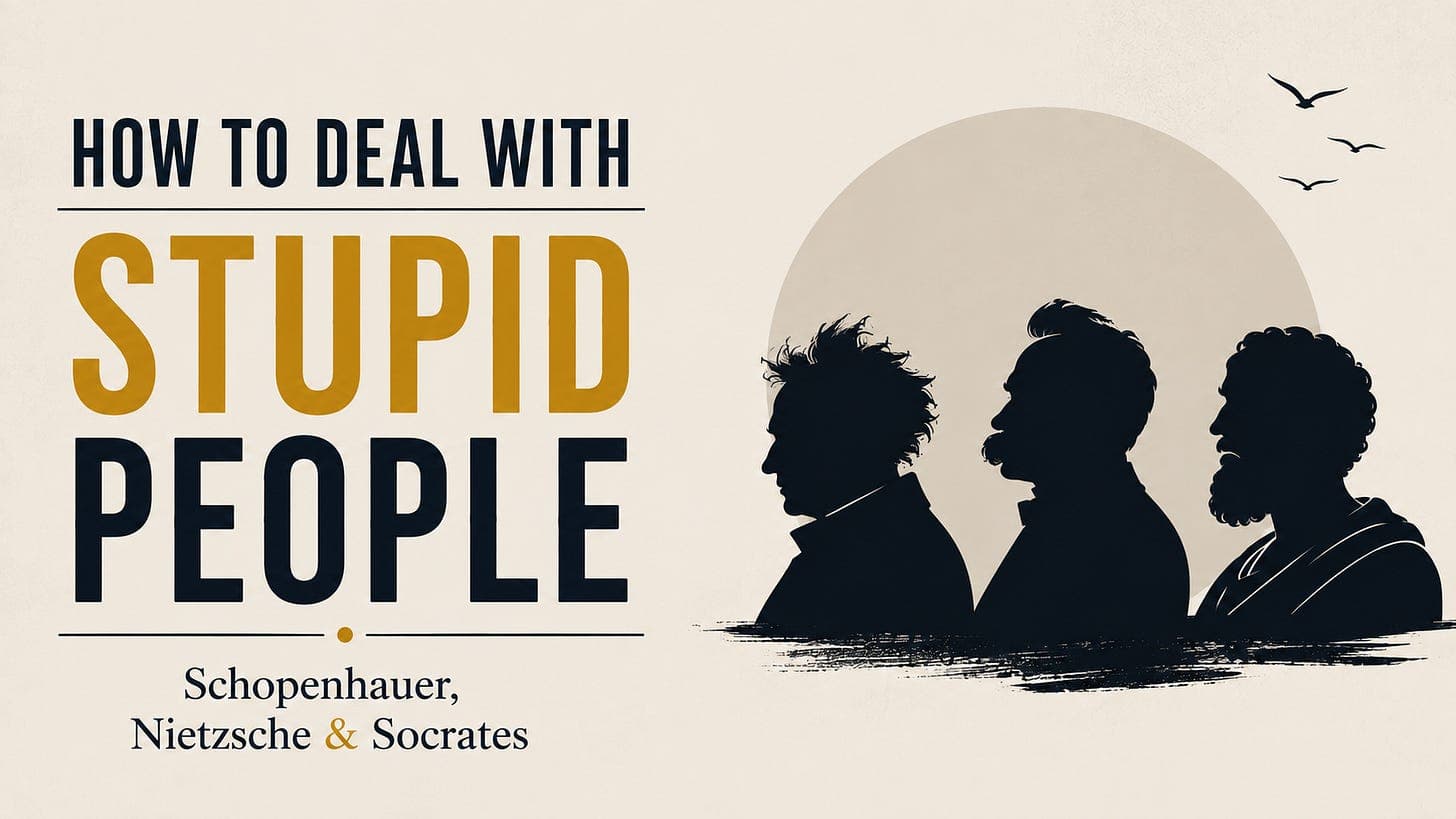
How to Deal With Stupid People — Schopenhauer, Nietzsche & Socrates
In summary, the essence of wisdom, as shared by Schopenhauer, Nietzsche, and Socrates, lies in maintaining mental clarity and resilience amidst foolishness.
Headlines
- Silence is a Shield. Schopenhauer sees silence as self-preservation against the noise of vain conversations.
- Distance Guards the Mind. Nietzsche argues that distancing oneself from mediocrity prevents the spread of mediocrity.
- Engage with Questions, Not Arguments. Socrates demonstrated that meaningful questions can illuminate truth without confrontation.
- Guard Your Energy. All three philosophers emphasize protecting your mental space from unnecessary drain.
Things
- People: Arthur Schopenhauer, Friedrich Nietzsche, Socrates, Adam Reed
- Places: Frankfurt, Athens
- Numbers: Nineteenth century, centuries earlier
- Things & Concepts: Silence, distance, questions, wisdom, foolishness
Three Philosophers on Silence, Distance, and Staying Wise in a Foolish World.
[

](https://substack.com/@adamreed2)
Aug 09, 2026
215
13
29
Share
Introduction
In nineteenth-century Frankfurt, a bitter old philosopher sat alone in a café, eating his lunch in silence, glaring at anyone who dared interrupt his thoughts. His name was Arthur Schopenhauer. He was famous for two things: his brilliance, and his contempt for the human race.
He once said that he preferred the company of his poodle to the company of most people. Why? Because, in his eyes, the poodle never said anything foolish.
Schopenhauer was not alone in this frustration. Centuries earlier, in the crowded streets of Athens, a barefoot philosopher named Socrates wandered the marketplace asking questions that made powerful men look like fools. And decades after Schopenhauer, a sickly professor named Friedrich Nietzsche warned that the greatest danger to a thinking man was not his enemies. It was the constant, grinding noise of stupidity around him.
Three very different minds. One shared problem.
How do you survive in a world full of people who cannot think clearly?
This is not a modern complaint. It is ancient. And these three men, in their own ways, built a kind of armor against it.
Schopenhauer: Silence Is a Form of Superiority
Schopenhauer believed that most human conversation was noise dressed up as meaning. He watched people argue, gossip, and boast, and he saw very little real thought behind any of it.
His advice was blunt.
Do not expect people to be reasonable. Expect them to be vain.
He believed that most people do not want truth. They want to feel important. And once you understand this, arguments become much easier to avoid.
Schopenhauer compared foolish people to poorly tuned instruments. You cannot fix them by shouting louder. You cannot fix them by explaining more clearly. The flaw is not in your explanation. The flaw is in the instrument itself.
He put this thought into a single sharp line:
“A man’s face as a rule says more, and more interesting things, than his mouth, for it is a compendium of everything his mouth will ever say.”
In other words, you often know who you are dealing with before the argument even begins.
So what do you do?
You stop trying to tune instruments that were never built to play your music.
This sounds harsh. But there is a strange relief inside it. Because once you accept that not everyone can be reasoned with, you stop carrying the exhausting burden of trying.
This is why he valued solitude so highly. Not because he hated people entirely, but because he refused to let foolishness drain his energy. Silence, for Schopenhauer, was not weakness. It was self-preservation.
Your support keeps the writing going — buy me a coffee to fuel the next piece.
Nietzsche: Contempt Is a Dangerous Weapon
Nietzsche took this idea somewhere darker and somewhere sharper.
He believed that stupidity was not just annoying. It was contagious.
Spend enough time around small minds, he warned, and you begin shrinking to fit inside their world. You start lowering your standards just to be understood. You start simplifying your thoughts just to be accepted.
Nietzsche called this the slow poison of mediocrity.
His solution was not gentle patience. It was distance.
He believed that a strong mind must protect itself the way a lion protects its territory. Not every creature deserves entry. Not every voice deserves influence.
Nietzsche warned of this danger directly:
“Whoever fights monsters should see to it that in the process he does not become a monster.”
The lesson is simple. Fight foolishness with too much anger, and you risk becoming just as small as the thing you are fighting.
But Nietzsche also warned against something else, something many people overlook.
He warned against contempt itself.
Because the moment you begin mocking foolish people, feeling superior to them, enjoying your own cleverness in comparison to their ignorance, you have already lost something valuable. You have let their stupidity define your identity.
Nietzsche believed that true strength does not need an enemy to measure itself against. A powerful mind does not need to look down on weaker minds to feel tall.
So his real teaching was this.
Walk away, not because you are better than them, but because your energy belongs somewhere higher.
Do not fight fools to prove your intelligence. Fighting them proves nothing except that you were willing to enter their arena.
Socrates: The Wisdom of the Question
If Schopenhauer taught withdrawal, and Nietzsche taught distance, Socrates taught something almost the opposite. He taught engagement, but engagement on his own terms.
Socrates rarely argued directly. Instead, he asked questions.
When a man claimed to understand justice, Socrates asked him to define it. When another claimed to understand courage, Socrates asked him to explain it clearly. Slowly, patiently, the man’s own confidence would collapse under the weight of his own contradictions.
This was not cruelty. It was a mirror.
Socrates understood something profound about foolish confidence. Most foolish people do not know that they are foolish. They believe they already understand the world. And you cannot pour wisdom into a cup that someone believes is already full.
So instead of lecturing, Socrates questioned.
Instead of declaring people wrong, he let them discover their own confusion.
This is perhaps the most disciplined form of dealing with foolishness. Not silence. Not distance. But calm, careful questioning that reveals the truth without ever raising your voice.
Socrates is remembered for one humble admission above all:
“I know that I know nothing.”
And he offered a second warning worth carrying into every difficult conversation:
“The only true wisdom is in knowing you know nothing.”
This single idea carried more power than any argument he ever won. Because true wisdom begins with humility, and foolishness almost always begins with false certainty.
Three Paths, One Lesson
Schopenhauer withdrew into silence. Nietzsche demanded distance. Socrates used gentle questioning as a mirror. Different methods. Same core belief.
You cannot force wisdom onto an unwilling mind.
Every day, the world offers endless opportunities to argue. Social media, family debates, workplace disagreements, strangers online who are certain of things they barely understand. And every single time, you face the same choice these three philosophers faced centuries ago.
Do you fight? Do you walk away? Do you question calmly and let the other person see themselves clearly?
There is no single correct answer. But there is a single correct principle underneath all three approaches.
Guard your mind first. Everything else is secondary.
Because the true danger of stupid people is not their opinions. It is what those opinions can do to you if you let them in unguarded. Anger. Frustration. Wasted hours. A mind pulled downward into noise instead of rising toward clarity.
Conclusion
Not every fool deserves your silence. Not every fool deserves your questions. And certainly, no fool deserves your anger.
Schopenhauer would tell you to walk away. Nietzsche would tell you not to shrink yourself to their level. Socrates would tell you to ask one simple question and let them hear their own confusion.
Three different men, three different centuries, one shared understanding.
The mind that reacts to every provocation is a mind that is never truly free.
And so the real skill in life is not learning how to defeat stupid people.
It is learning how to remain wise in their presence, without losing yourself to their noise.
